
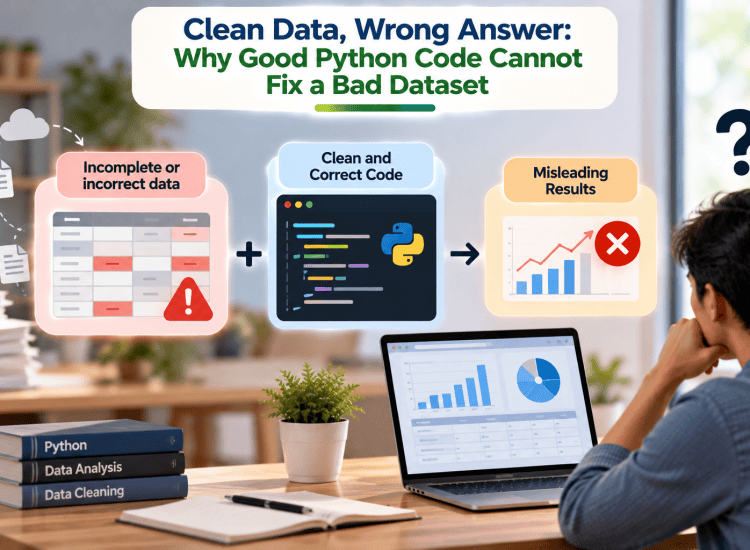
A program can run perfectly and still produce a misleading answer. This is one of the most important lessons for anyone interested in a python for data science course. Writing correct code is only one part of working with information. If a dataset contains missing values, duplicate records, inconsistent entries, unusual values, or hidden bias, even carefully written programs can generate conclusions that look convincing but are fundamentally wrong.
The problem is easy to miss because programming errors are usually visible. A broken program may display an error message, while a poor dataset can quietly pass through the entire process. Calculations can be accurate, charts can look professional, and the final numbers can appear precise. But the result may still not be reliable.
Python can process information quickly and consistently, but it cannot automatically determine whether every value represents reality correctly. A calculation performed on inaccurate information remains inaccurate.
Imagine a customer dataset containing missing ages, repeated records, and a few impossible values. A program can calculate averages and create summaries without reporting a problem. The issue is not necessarily the code. The issue is the information being processed.
This distinction is central to data quality. Good programming determines how information is processed, while good data determines whether the resulting answer deserves confidence.

Missing information is common in real-world datasets. A blank field may mean that information was forgotten, unavailable, not collected, or simply not applicable. Treating every blank in exactly the same way can create misleading results.
Suppose a dataset records customer spending, but many high-value customers have missing spending figures. Removing every incomplete record could make average spending appear lower than it actually is. Replacing every blank with zero could create another distortion.
Data tools can identify missing values, but deciding what they mean requires context. Pandas provides methods for detecting, removing, and filling missing values, including isna(), dropna(), and fillna().
The important lesson is that cleaning should not mean blindly changing blanks. It should mean understanding why information is missing and choosing an appropriate response.
Duplicates are another quiet source of error. A record may appear more than once because of repeated data entry, an import problem, or information being combined from multiple sources.
Suppose one transaction is accidentally recorded three times. A program will treat those entries as three transactions unless the dataset is checked first. Total sales, customer counts, averages, and other measurements can therefore become inflated.
The solution is not simply to delete anything that looks similar. Two records may share several details while legitimately representing separate events. Effective cleaning requires understanding which fields identify a unique record and how the information was collected.
This is why data validation matters before analysis begins. Validation helps determine whether records follow expected rules and whether unusual entries need investigation.
Information can be incorrect without looking obviously wrong. Dates may appear in different formats. Numbers can contain spaces or symbols. Categories may use different spellings. One source might record a city as “Delhi,” while another uses “delhi.”
A program may treat those values as separate categories even though they represent the same location. The analysis can then divide one group into several smaller groups and make patterns harder to recognize.
Standardizing formats can solve many problems, but it must be done carefully. Changing values without understanding their meaning can introduce new errors instead of correcting existing ones.
Good data preparation therefore requires both technical awareness and logical thinking.
An unusual value can be either a mistake or an important discovery. A customer spending far more than everyone else might have been entered incorrectly, but the same value could represent a genuinely valuable customer.
Automatically deleting every extreme value may make a dataset appear cleaner while removing meaningful information. Ignoring obvious errors can create the opposite problem.
The better approach is to investigate unusual records. Ask whether the value is possible, whether it matches the original source, and whether there is a reasonable explanation.
This is where human judgment remains important. Software can identify unusual observations, but context helps determine what those observations actually mean.
A dataset can contain accurate individual records and still be unsuitable for a particular question. This happens when the information does not represent the population being studied.
For example, if feedback is collected only from the most active customers, the results may not represent occasional customers. Every response may be genuine, yet the overall conclusion can still be incomplete.
Programming cannot completely remove a problem created by an unsuitable source. Before analyzing information, it is therefore important to ask whether the dataset actually represents the people, events, or situations being studied.
This is a major part of data quality because reliability depends not only on whether values are correct, but also on whether they are relevant.
A common mistake is to start interpreting patterns before checking the foundation of the dataset. Analysts may immediately calculate summaries or create visual representations because the information appears ready to use.
A better approach begins with inspection. Check the structure of the dataset, identify missing information, look for duplicates, examine unusual values, review formats, and compare important fields against expected rules.
Cleaning is not simply about making information look tidy. It means understanding what the values show and deciding whether they are suitable for the analysis.
This approach also makes programming more meaningful. Instead of writing code first and questioning the results later, the analyst considers the reliability of the input before trusting the output.
The most dangerous dataset problems are not necessarily the ones that make a program crash. They are the ones that produce believable answers.
A broken calculation may be noticed quickly. A plausible but incorrect result can influence decisions for much longer because people may assume that a precise percentage or attractive chart must be trustworthy.
This is why results should be questioned rather than accepted automatically. Compare important findings with the original source, investigate unexpected patterns, and consider whether the conclusion makes sense in context.
A useful habit is to separate three questions: Is the code working? Is the dataset reliable? Does the result make sense? All three deserve attention.
People exploring a python for data science course should develop more than programming confidence. They should learn to think critically about the information entering a program.
Strong analytical work combines technical accuracy with careful observation. Someone who knows how to write code but cannot recognize suspicious information may produce weaker results than someone who takes time to examine the dataset first.
Understanding data validation also changes the way programming problems are approached. Instead of asking, “How do I calculate this?” a better question is, “Can I trust the information I am calculating from?”
That shift is valuable because real-world information is rarely perfect. It may come from different sources, contain gaps, include inconsistent records, or reflect only part of a population.

Good Python code is powerful, but it cannot transform unreliable information into a reliable answer. Missing values, duplicate records, inconsistent formats, unusual observations, and biased datasets can influence results even when the underlying program works exactly as intended.
Good analysis requires correct coding, careful data checking, and a clear understanding of the original data. Data cleaning is not just about making a dataset look neat. It is about understanding what the values represent and deciding whether they are suitable for the question being asked.
For anyone considering a python for data science course, this mindset is essential. Code is the tool that processes information, but the quality of that information shapes the answer. Before trusting the output, check the foundation. When reliable data and sound programming work together, the results become more meaningful, defensible, and useful.

